

Date:
July 29, 2024
 Strategy & Growth
For businesses developing a brand strategy in Oman, the challenge is rarely the absence of a logo, website, or social media presence. The deeper challenge is whether the market clearly understands what the business represents, who it is for, why it matters, and why a customer should choose it over alternatives.
As markets become more competitive, businesses can easily begin to look and sound similar. The same claims appear repeatedly—quality, service, innovation, experience, trust, and value—without creating a meaningful reason for customers to prefer one company over another.
The opportunity is therefore not simply to improve visual identity. It is to build a connected brand strategy that aligns positioning, customer understanding, commercial direction, experience, communication, and growth.
⋙ What Brand Strategy Actually Means for a Business :
Brand strategy defines how a business intends to occupy a distinctive position in the market and how that position should influence customer perception, communication, experience, and commercial decisions.
It connects what the company offers with what customers value and what competitors already represent.
A strong brand strategy helps answer several fundamental questions:
Who are we trying to serve?
What problem, desire, or opportunity are we meaningfully associated with?
What makes our position different from the alternatives?
What should customers understand and remember about us?
How should that position influence product, pricing, customer experience, marketing, and growth?
Brand strategy therefore moves the conversation from “How should the brand look?” to “What position should the business own in the customer’s mind?”
⋙ Why Generic Positioning Makes Growth More Difficult :
Many businesses communicate professionally but remain difficult to distinguish.
The website may look polished. Social media may be active. Advertising may generate attention. Products or services may be competitive.
But if the market cannot identify a distinctive reason to choose the business, every marketing activity has to work harder.
Common signs of weak or generic positioning include:
◉ The brand uses the same claims as most competitors
◉ Customers primarily compare the business on price
◉ Marketing generates visibility without strong preference
◉ Different teams describe the business in different ways
◉ The website lists services but does not communicate a clear market position
◉ Brand communication changes constantly between campaigns
◉ Customers understand what the company sells but not why it is distinctive
◉ Visual identity feels disconnected from the actual business proposition
◉ Sales teams struggle to explain why customers should choose the company
◉ Growth depends heavily on promotions, discounts, or paid visibility
The problem is not always poor marketing execution. Often, the business is asking marketing to compensate for a positioning problem.
A stronger brand strategy creates clarity before the business spends more aggressively on communication and acquisition.
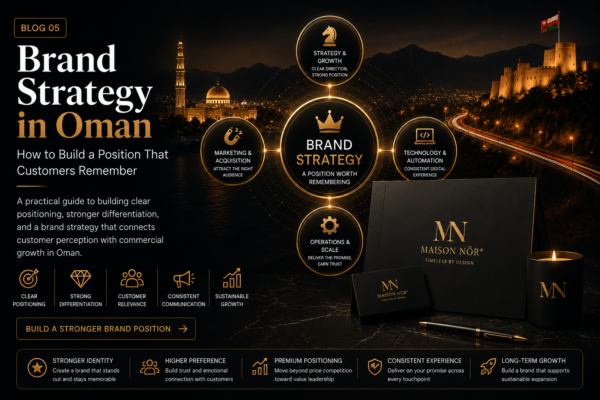
⋙ The Four Layers of a Connected Brand Strategy :
A strong brand is not created by visual identity alone. It is created when strategic direction, market communication, digital experience, and business execution reinforce the same position.
For AL AFAQ, this can be understood through four connected layers:
Brand strategy begins with understanding the business itself—its market, customers, competitive position, capabilities, commercial model, priorities, and growth opportunities.
The objective is to identify where the business can create a distinctive and defensible position rather than simply communicating more loudly than competitors.
Positioning becomes valuable when it shapes how the business enters the market.
Messaging, content, paid media, SEO, social communication, campaigns, and conversion experiences should reinforce the same strategic position rather than presenting different versions of the brand across channels.
Strong positioning can make acquisition more efficient because the customer understands more quickly who the business is for and why it matters.
Digital systems influence how customers experience the brand.
Websites, CRM, e-commerce, customer communication, automation, forms, booking systems, and digital interfaces should support the promise the brand makes.
A premium position, for example, becomes weaker if the digital customer experience feels fragmented or inconsistent.
A brand promise only becomes credible when the business can deliver it consistently.
Service standards, processes, team behaviour, customer journeys, fulfilment, communication, and quality control all influence how the market ultimately perceives the brand.
Operations therefore turn positioning from communication into experience.
The value comes from the connection between these layers. Strategy defines the position. Marketing communicates it. Technology supports the experience. Operations make the promise real.
⋙ Positioning, Identity, Messaging, and Experience: What Is the Difference?
Brand discussions often mix several different concepts together. Understanding their roles helps prevent visual design from replacing strategic thinking.
Positioning defines the place the business wants to occupy in the market relative to customer needs and competitive alternatives.
Brand identity translates that strategic direction into recognizable visual and verbal expressions—name, typography, colour, visual system, tone, and other identity elements.
Messaging determines how the business explains its value, difference, offer, and relevance to different audiences.
Customer experience determines whether the reality of interacting with the business supports the expectations created by the brand.
These elements should reinforce each other.
A distinctive identity without distinctive positioning may attract attention but remain commercially unclear.
Strong messaging without a consistent customer experience can create expectations the business cannot sustain.
A powerful position without clear communication can remain invisible to the market.
This is why effective branding is less about producing isolated creative assets and more about building a strategic market position that can guide the wider business.
⋙ A Practical Brand Strategy Roadmap :
Brand strategy becomes more useful when it follows a structured sequence rather than beginning immediately with design or campaign execution.
Start with the business, market, customers, competitors, category expectations, commercial model, existing perception, and growth objectives.
The objective is to identify what customers value, where competitors concentrate, and where the business may have an opportunity to create meaningful difference.
Clarify the target customer, market category, customer problem or aspiration, commercial proposition, competitive frame, and the position the business intends to build.
This creates the strategic foundation of the brand.
Identify what the business can credibly emphasize that competitors do not communicate, deliver, or own as strongly.
Differentiation may come from product, experience, specialization, business model, craftsmanship, access, technology, customer understanding, service, or another meaningful dimension.
The difference needs to matter to the customer—not simply sound different internally.
Translate the position into identity, messaging, visual direction, tone, website, content, and other customer-facing expressions.
The objective is consistency between what the business means and what customers perceive.
Align the customer experience and operational behaviour with the position.
A premium promise should produce a premium experience. A convenience position should reduce friction. A specialist position should demonstrate expertise throughout the journey.
Brand position is built through consistency over time.
Measure customer response, market perception, acquisition performance, conversion, retention, pricing power, and other relevant signals.
Then refine the brand without constantly changing its core direction.
Understand the market. Define the position. Differentiate meaningfully. Express it clearly. Deliver it consistently. Strengthen it over time.
⋙ Brand Strategy in Oman: Why the Market Context Matters :
Businesses in Oman operate within a market where customers can increasingly compare local companies with regional and international alternatives.
Digital platforms, social media, e-commerce, search, travel, and cross-border exposure have expanded the reference points customers use when evaluating brands.
This creates a higher standard for businesses seeking to build premium, specialist, modern, or distinctive market positions.
A company may compete locally, but the customer’s expectations are not necessarily local.
At the same time, effective brand strategy in Oman should not simply imitate global brands.
Customer expectations, cultural context, trust, language, category behaviour, purchasing patterns, service expectations, and regional expansion ambitions can all influence how a position should be developed.
The strongest opportunity is often to combine local market understanding with a level of strategic clarity and execution capable of competing beyond the local market.
For businesses building a brand strategy in Oman, the objective is therefore not to appear international for its own sake. It is to build a position that is commercially relevant, culturally intelligent, and capable of supporting long-term growth.
⋙ What Makes a Brand Position Strong?
A useful positioning strategy should do more than sound attractive in a presentation.
It should help the business make decisions.
A strong position is typically:
◉ Clear — customers can understand it quickly
◉ Relevant — it addresses something customers actually value
◉ Distinctive — it creates meaningful separation from alternatives
◉ Credible — the business can realistically deliver the promise
◉ Consistent — the same strategic direction appears across major touchpoints
◉ Commercial — it supports customer acquisition, preference, pricing, retention, or growth
◉ Scalable — it can remain useful as the business expands
◉ Defensible — competitors cannot easily copy the entire underlying proposition
A strong position should also create boundaries.
If a brand strategy is broad enough to include every possible customer, product, message, and market opportunity, it may not be a strategy at all.
⋙ When Does a Business Need Repositioning?
Businesses evolve, but their market position does not always evolve with them.
A company may need to revisit its brand strategy when:
◉ Customers primarily choose based on price
◉ The business has outgrown its original identity
◉ Competitors increasingly look and sound similar
◉ The company has expanded into higher-value services or products
◉ The brand attracts the wrong type of customer
◉ Marketing activity feels inconsistent across channels
◉ The business is entering a new market or customer segment
◉ Customer perception no longer reflects the quality of the company
◉ The current brand limits pricing or commercial ambition
◉ Employees struggle to explain the company’s differentiation
◉ The website communicates services but not a clear reason to choose the brand
◉ Growth requires a stronger and more scalable commercial identity
Repositioning does not necessarily mean changing everything.
Sometimes the stronger move is to clarify the existing strategic value, remove unnecessary complexity, and align communication around a position the business already has the ability to own.
⋙ Positioning in Practice: MAISON NŌR®
MAISON NŌR® illustrates the importance of understanding a business beyond its surface identity before deciding how it should appear in the market.
The strategic opportunity was not simply to create a more polished luxury image. It was to connect brand identity, market positioning, customer expectations, and the commercial direction of the business around one clearer proposition.
This distinction matters because luxury positioning cannot be created through visual styling alone.
The customer needs to experience consistency between the identity, product or service, communication, digital experience, presentation, and expectations created by the brand.
The broader principle applies across industries: stronger branding begins when the company understands what position it can credibly own and then aligns the business around that position.
⋙ Building a Brand That Supports the Next Stage of Growth :
A strong brand is not defined by how recognizable its logo becomes.
Its commercial value comes from creating a position customers understand and a business experience that reinforces that position.
For businesses in Oman, that may require deeper market understanding, stronger differentiation, clearer messaging, a more coherent identity, better customer experience, or repositioning the business around a more valuable opportunity.
The right brand strategy therefore starts with understanding the business first—its customers, market, competitive position, capabilities, ambitions, and commercial model—before deciding how the brand should look or communicate.
If your business is growing but its market position no longer reflects its value or ambition, AL AFAQ can help identify the strategic position and brand architecture required for the next stage of growth.
Start With Your Business →