

Date:
July 29, 2024
 Technology & Automation
For businesses exploring business automation in Oman, growth often creates more manual work before it creates more efficiency—more enquiries, more data entry, more follow-ups, more approvals, more reporting, and more information moving between disconnected systems.
As this complexity increases, teams can become occupied with repetitive coordination instead of higher-value work. Customer information may need to be entered more than once, routine tasks depend on individual employees, and management struggles to maintain clear visibility across operations.
The real opportunity is not simply to automate more tasks. It is to build a connected business automation system where technology supports how the company actually operates and grows.
⋙ What Business Automation Actually Means :
Business automation is the structured use of technology to reduce repetitive manual activity, connect information, coordinate workflows, and make recurring business processes more consistent.
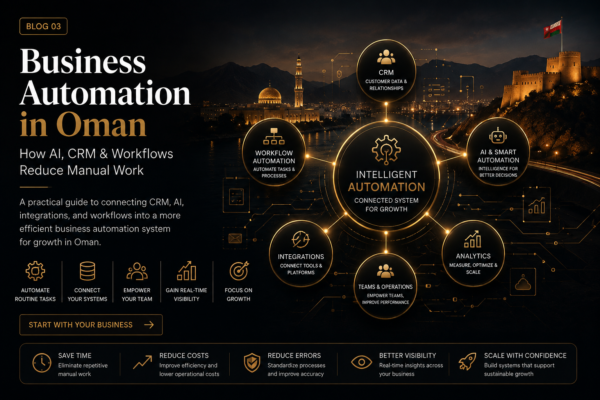
A connected automation environment can bring together CRM, ERP, websites, forms, communication platforms, internal workflows, analytics, AI, and other business systems around clearly defined processes.
This changes the question from “What can we automate?” to “Which workflows should exist, how should information move, and where can technology remove unnecessary friction?”
Automation then becomes part of the operating architecture of the business—not a collection of isolated shortcuts.
⋙ Why Manual and Disconnected Workflows Limit Growth :
Manual processes are rarely a major problem when a business is small and activity is limited. The difficulty appears when volume, teams, customers, systems, and operational complexity begin to grow.
A process that takes five minutes may appear insignificant until it is repeated hundreds of times every month. Manual handoffs create delays, duplicated data creates inconsistency, and workflows that depend on individual employees become harder to control as the business expands.
The problem is not manual work itself. The problem is allowing repetitive operational activity to grow without a structured system behind it.
Common signs that business workflows need improvement include:
◉ Customer or operational data being entered repeatedly
◉ Teams copying information between different platforms
◉ Follow-ups depending on individual memory or manual reminders
◉ Routine approvals creating unnecessary delays
◉ Reports requiring repeated manual preparation
◉ Customer enquiries being routed manually between employees
◉ Different departments maintaining separate versions of the same information
◉ Processes slowing down as transaction volume increases
◉ Management lacking real-time visibility across workflows
◉ Employees spending significant time on repetitive administrative activity
A connected automation system reduces this friction by defining how information, actions, decisions, and responsibilities should move through the business.
⋙ The Four Layers of Intelligent Business Automation :
Effective automation does not begin with software. It begins with understanding how the business should work and then applying technology to the right parts of that architecture.
For AL AFAQ, this can be understood through four connected layers:
Automation should support business priorities rather than exist simply because a task can technically be automated.
The company first needs clarity around its commercial objectives, operational constraints, customer journey, growth priorities, and the processes that create the greatest friction or opportunity.
Automation can support the movement from market attention to customer action through lead capture, qualification, routing, follow-up, CRM updates, lifecycle communication, and performance measurement.
The objective is to reduce leakage while preserving a coherent customer experience.
This layer provides the infrastructure behind connected workflows—CRM or ERP systems, integrations, APIs, automation platforms, AI capabilities, websites, databases, analytics, and business applications.
The goal is to create a technology environment where systems exchange information reliably and each platform has a clear role.
Automation becomes valuable when it improves the actual execution of the business. Processes, responsibilities, approvals, customer journeys, data movement, and performance monitoring must remain visible and manageable as complexity increases.
A scalable operating architecture allows automation to support growth without creating additional layers of confusion.
The value comes from the connection between these layers. Strategy identifies what matters, technology enables the workflow, automation coordinates recurring activity, and operations ensure the process remains controlled and useful.
When these layers work together, automation becomes an operating capability—not simply a productivity tool.
⋙ Where CRM, ERP, Workflow Automation, and AI Fit :
Different technologies solve different parts of the automation architecture. CRM, ERP, workflow automation, integrations, and AI should not be treated as interchangeable solutions.
CRM structures customer and commercial information. It provides a consistent environment for managing leads, opportunities, interactions, follow-up, and customer relationships.
ERP and Business Systems organise operational information across functions such as finance, inventory, projects, purchasing, fulfilment, or internal administration depending on the needs of the business.
Workflow Automation coordinates recurring actions between people and systems. It can trigger tasks, move information, send notifications, update records, route requests, and reduce repetitive manual coordination.
Integrations allow different platforms to exchange information so that data does not remain trapped inside disconnected tools.
AI can add an intelligence layer to appropriate workflows—supporting classification, summarisation, analysis, customer interactions, content operations, information extraction, or other knowledge-based tasks where the process and data are sufficiently structured.
The sequence matters. Automating a broken workflow can make inefficiency move faster. Adding AI to inconsistent information can make results less reliable. Connecting systems without defining ownership can simply distribute confusion across more platforms.
This is why effective automation begins with engineering the right technology and workflow architecture before deciding which tasks should be automated or augmented with AI.
⋙ A Practical Business Automation Roadmap :
Business automation becomes easier to manage when the company follows a deliberate sequence instead of automating isolated tasks whenever a new tool appears.
Map how work currently moves through the business—customer interactions, team responsibilities, approvals, systems, data, reporting, and recurring operational activity.
The objective is to understand where time is being lost, where information becomes fragmented, and which processes create the greatest friction.
Before automating a workflow, remove unnecessary steps, duplicated approvals, unclear responsibilities, and redundant data movement.
A simpler process is usually easier to automate, manage, and improve.
Identify which systems need to exchange information and establish a clear source of truth for customer, operational, or commercial data.
This may involve connecting CRM, ERP, forms, websites, communication platforms, databases, analytics, or other business tools.
Automate repetitive and predictable activity where doing so improves speed, consistency, accuracy, or customer experience.
Automation should remove unnecessary coordination without eliminating the human judgement required in important decisions.
Define what successful automation should improve—response time, processing time, error rates, team capacity, customer experience, workflow visibility, or other relevant business outcomes.
Measurement ensures automation creates operational value rather than simply technical activity.
Workflows evolve as the company grows. New systems are introduced, responsibilities change, customer behaviour shifts, and new operational constraints appear.
The automation architecture should therefore be reviewed continuously—removing bottlenecks, strengthening integrations, improving controls, and extending automation only where it adds meaningful value.
A strong automation roadmap follows this sequence deliberately. Understand the workflow. Simplify it. Connect the right systems. Automate the right activity. Measure the outcome, then improve what matters.
⋙ Business Automation in Oman: Why the Context Matters :
Oman is increasingly positioning digital technology and artificial intelligence as important enablers of economic development. Oman Vision 2040 places innovation, private-sector development, competitiveness, and technology within the country’s long-term economic direction.
This direction is also reflected in Oman’s National Programme for Artificial Intelligence and Advanced Digital Technologies, which includes the adoption of AI across economic and development sectors and identifies operational efficiency as one of the areas where advanced technologies can create value.
For businesses operating in Oman, this creates an environment where automation is becoming increasingly relevant not only as a technology initiative, but as an operational capability.
The opportunity is not to automate every activity. It is to identify where connected systems, workflow automation, CRM, AI, and better data movement can improve the way the business serves customers and executes work.
For growing companies, the question therefore becomes less about whether automation is available and more about which business processes should be automated, connected, or redesigned first.
⋙ When Does a Business Need Workflow Automation?
A business may be ready for automation when operational complexity begins consuming more time and attention than the underlying work should require.
Common warning signs include:
◉ Teams repeatedly copy the same information between systems
◉ Customer enquiries require multiple manual handoffs
◉ Routine follow-ups are delayed or forgotten
◉ Approvals depend heavily on email or messaging threads
◉ Reports require repeated manual data collection
◉ CRM or ERP systems are not connected to the workflows around them
◉ Employees spend significant time on predictable administrative work
◉ Customers receive inconsistent communication depending on who manages the request
◉ Management cannot easily see where work is delayed
◉ Growth requires adding administrative capacity faster than expected
Not every manual process should be automated. Tasks involving judgement, complex exceptions, sensitive decisions, or infrequent activity may still be better handled by people.
The objective is not maximum automation. It is to create a business environment with less operational friction, better information flow, stronger consistency, and more scalable execution.
⋙ Connected Automation in Practice: AURA METHOD®
AURA METHOD® demonstrates how connected systems can support a business when customer activity needs to move across multiple stages of the commercial and operational journey.
Acquisition, booking, customer experience, membership management, and retention were designed to operate as connected parts of one wider system rather than separate activities.
The architecture created clearer relationships between customer interactions and the workflows supporting recurring membership value.
The broader principle applies beyond wellness: automation creates greater value when customer activity, business systems, data, workflows, and operations are designed to work together rather than being automated independently.
⋙ Building a More Intelligent Operating System for Growth :
Business automation is not defined by the number of workflows a company automates. It is defined by how effectively technology reduces friction while improving how people, systems, information, and processes work together.
For businesses in Oman, the opportunity may involve connecting CRM or ERP systems, automating customer follow-up, improving internal workflows, integrating business platforms, applying AI to appropriate tasks, or redesigning the processes behind recurring operational activity.
The right automation architecture therefore starts with understanding the business first—its workflows, systems, customer journey, responsibilities, constraints, and growth objectives—before deciding what should be connected, automated, or augmented with AI.
If your business is growing but manual processes and disconnected systems are becoming harder to manage, AL AFAQ can help identify where automation can create the greatest operational and commercial value.
Start With Your Business →